This is a deep dive from our roundup of 25 AI prompts and workflows that speed up SEO turnaround time. Here we focus on the brief — the stage where most AI content quietly goes wrong.
The reason so many teams try AI for on-page work, get burned once, and never return is almost always the same: the model didn’t have the client’s real context, so it invented things — most damagingly, internal links to pages that don’t exist. The five workflows below fix that by loading context once and then forcing the model to check its own work.
Load the client once, then keep prompts short
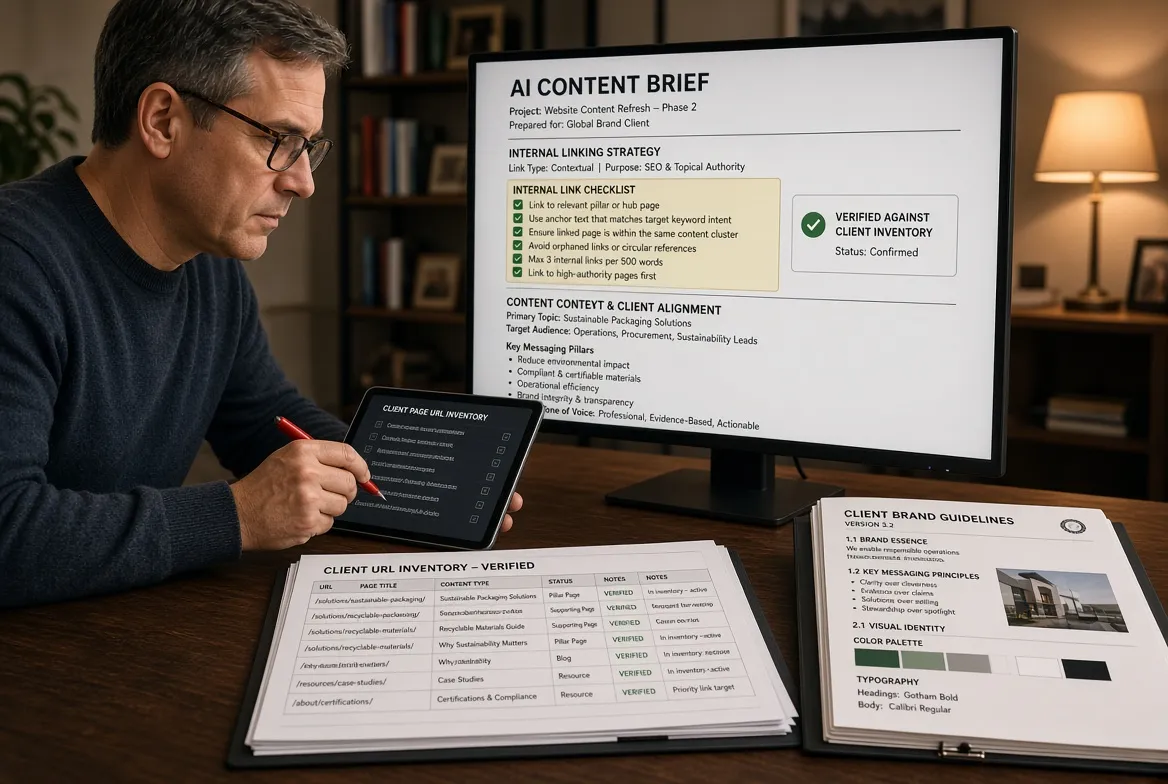
TJ Loftus stopped re-explaining each client from scratch. He builds a dedicated project per client and loads it once with the brand voice guide, the ICP and sales-call objections, a full URL inventory (every page with its target keyword and current position), the internal link map, SERP notes, and CMS constraints. After that, prompts get short and the first draft is usable.
His brief prompt is four parts, and the order matters:
- Recall the constraints first — “Before you answer, pull the three pages from the URL inventory closest in intent to [keyword] and tell me whether we should build something new or consolidate what’s there.”
- The actual task.
- The output format, spelled out — H1, H2s, word count per section, entities to cover, internal links with the exact anchor text from the inventory.
- Make it check its own work — “Go back through your draft against the inventory. Flag any anchor pointing at a URL that doesn’t exist, and any section that overlaps with page X.”
Steps 1 and 4 do most of the work: the first stops it proposing a page you don’t need, the last catches hallucinated internal links. Briefs went from ~3 hours to ~25 minutes.

Set the rules before you ask for an outline
Curtis Chappell runs a dedicated chat per client and front-loads the constraints: the persona of a 20-year SEO professional in his market, then explicit rules — no em dashes, UK English, professional tone, relevant industry jargon. Only then does he paste a URL list for internal linking (minimum 5 internal links, at least one to a related blog article), require at least 2 outbound links to industry or government sources, supply the primary keyword and ask for 4+ variants at 1–2% density, request the schema code, and generate a 60-character title and 160-character meta description. Every article is still reviewed and edited by hand.

Wire the model to your keyword tool and voice guide
Aled Nelmes gets four ready-to-use blog plans from a single prompt — because Claude is connected to SEMrush and loaded with the client’s tone-of-voice guidelines. The prompt asks for four sets of: keywords and their search volumes, a suggested H1 targeting the main question, at least five H2s targeting related questions, and bullet points under each subheading, all in one document, for a defined target market and problem.
“Make the H1 title target the main commonly asked question or topic, and the H2 subheadings target related questions that fall under that one topic.”

Feed it real buyer language, not keywords
Daniel Plumtree’s team feeds the model twenty to thirty of the client’s own sales-call transcripts before asking anything about content. The prompt runs one direction: list every question a prospect asked, group the ones asking the same thing in different words, and rank the groups by frequency. They never ask for keywords — they map the resulting buyer language against search volume afterward. The result is language nobody else in the SERP has, and brief production dropped from two days to under two hours per page.

Turn the whole audit into a reusable spec
Jason Morris took this idea to its conclusion and built a reusable Claude Skill for pre-sales audits: the only variable is the prospect’s URL, and everything else — scoring rubric, section order, language, brand voice, and strict “don’t invent metrics” guardrails — is fixed. It separates retrieval (gather live data first) from reasoning (evaluate against the framework), producing a branded audit in minutes instead of 2–3 hours. He still reviews every one before it reaches a client.

The takeaway
A good AI brief isn’t a cleverly worded prompt — it’s context loaded once and a self-check enforced at the end. Give the model your URL inventory, your voice guide, and your customers’ real questions, then make it verify every internal link against pages that actually exist. That single habit is the difference between AI content you rebuild and AI content you ship.
Read the full collection: 25 AI Prompts and Workflows That Speed Up SEO Turnaround Time »
Related deep dives: AI for SEO research & planning · Technical SEO automation
Want briefs your team can actually use? Talk to Salam Experts »